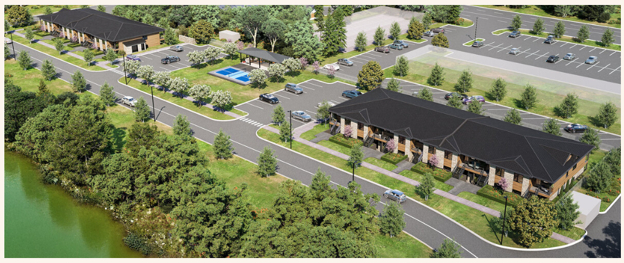
The Town of Saugeen Shores has been awarded funding from the Canadian Mortgage and Housing Corporation (CMHC) Housing Accelerator Fund. The funding will advance the Town’s ongoing efforts to expand housing opportunities, with an anticipated result of approximately 450 new homes in the next decade. The work will be carried out through eight municipal initiatives that will implement long-term strategies to increase housing opportunities in Saugeen Shores while removing barriers and streamlining approval processes.
The eight initiatives supported by the funding are:
1. Housing-Driven Community Planning Permitting and Housing Opportunities System (CPPS)
The Town of Saugeen Shores is aiming to implement a Community Planning Permit System (CPPS), a land use planning tool designed to streamline development. The CPPS consolidates zoning, site plan, and minor variance processes into one, reducing approval timelines from 90 to 45 days. This system enhances transparency and certainty for community members, landowners, and developers, while offering flexibility in defining land uses to align with local priorities, such as accelerating housing availability. The Town has previously conducted work on developing a CPPS and are now with the support of Housing Accelerator Funding, looking to implement the system.
Alongside the CPPS, the Town has proposed conducting a Nodes and Corridors Study to further support its implementation. This study will help identify areas where gentle density and/or mixed uses can be increased, and facilitate systemic changes within community infrastructure and improvement plans.
For more information and updates, visit our Community Planning Permit System project page.
2. Affordable Community Housing Improvement Plan
The objective of this project is to review and implement changes to (if identified) an Affordable Housing Community Improvement Program (CIP).
3. Official Plan and Zoning By-Law Amendments Related to Inclusionary Zoning
The Town made changes to the Towns Official Plan and Zoning By-law to provide greater housing opportunities and Additional Residential Unit (ARU) updates, including the following:
- Introduction of Inclusionary Zoning Policies
- New residential uses including triplexes and fourplexes are now permitted in most residential zones;
- Additional Residential Units are now permitted in a duplex and triplex;
- Reduction in parking where currently 2 stalls are required per principal unit/building, except where an ARU is provided, a maximum of 1 stall per unit is required;
- Maximum floor area of ARUs has been removed;
- Detached ARUs permitted if principal building is single-detached, semi-detached, duplex, triplex or street townhouse; and
- Can have 2 detached ARUs if lot is larger than 450 m2.
The intent of these changes are to remove barriers to housing development and increase housing diversity that is more affordable for residents of Saugeen Shores.
This project may require consideration of additional amendments to the Towns Official Plan and Zoning By-law to implement systemic policies that will enable inclusionary zoning within the community, allowing the Town to add new housing types for development, increasing density and infill opportunities. Inclusionary Zoning is a tool that can compel affordable housing to be constructed as part of developments.
4. Standardized Additional Residential Unit (ARU) Toolkits and Missing Middle Housing Program
With the support of Bruce Power Seed Funding, this project will create and implement new Toolkits for Additional Residential Units (ARUs) and Missing Middle housing. These Toolkits will standardize the development of ARUs and missing middle housing by simplifying the approval process, lowering development costs (including plans), encouraging the adoption of innovative housing designs, and educating residents about the process. The project will also feature architectural designs that can be shared and used throughout Saugeen Shores, making tiny homes as ARUs available at an affordable cost.
For more information on Additional Residential Units (ARUs), visit our Ready-to-build housing designs webpage.
5.Incentive Programming Tools Initiative
This initiative aims to enhance and streamline the process for evaluating and applying for incentive programs designed to support community housing development. This initiative is grounded in the financial analysis conducted through the Affordable Housing Community Improvement Plan (CIP) and is focused on ensuring that incentive programs are both effective and aligned with the community's housing needs.
6.Property Repurpose Program (PRP) to Convert Surplus and Underutilized Land to Housing
This initiative will establish new municipal policies and processes aimed at helping community developers and landowners transform surplus and underused land/buildings into affordable housing units for local residents. This will involve developing the following:
- A standardized method for evaluating surplus and underutilized properties to assess the feasibility of repurposing them into attainable housing developments;
- A municipal scoring matrix to assess lands and identify opportunities to convert these lots into priority housing types; and
- A framework that will be re-evaluated every 2-3 years to ensure it remains an effective tool for evaluating municipal lands, and to continuously improve our scoring assessment.
A component of this initiative includes the Affordable Housing on Town-Owned Lands Policy approved by Council in March 2024.
7. Non-Profit Housing Partnerships Initiative
Through the creation and solidification of long-lasting relationships with non-profit housing providers the Town can develop systemic changes that will integrate new strategies and best practices to nurture these evergreen partnerships. The implementation of potentially new municipal practices will allow the Town to adopt a “housing first” policy with these partners to facilitate the development of attainable and affordable housing, as well as to provide support for other community housing options.
8. Consolidation Linear Infrastructure Environmental Compliance Approval (CLI ECA) Process
The Ontario Ministry of the Environment, Conservation and Parks (MECP) has recently updated its Environmental Compliance Approval application process, now known as the Consolidated Linear Infrastructure Environmental Compliance Approval (CLI ECA). The Town is now responsible for managing these approvals.
To simplify this process, the Town in 2024 introduced an online application system for developers applying for municipal CLI ECAs related to the municipal sewage collection and stormwater management systems. This initiative has been completed.
Visit the Consolidated Linear Infrastructure Environmental Compliance Approval (CLI ECA) webpage for more information.
To track the progress of 2025 business plan initiatives, please visit our Performance Indicators for Development Services webpage.