Cycling

Saugeen Shores is a bronze designated bicycle friendly community and committed to providing safe trails and routes, promoting active transportation and offering ongoing education and outreach. Expand the sections below for more information about cycling in Saugeen Shores and surrounding communities.


Cycling and Trails Network

Use our interactive map to view cycling routes and trails including surface type, amenities and bicycle-friendly businesses. As new cycling and trail infrastructure is added to the network it will be updated in the map.

For information on closures, check the Closures and Disruptions section of our website.

Choosing active transportation whether cycling, walking, or rolling, has many benefits extending beyond the joy of riding for recreation! There are positive environmental, health, social, and economic benefits from adding more active transportation into your day. Learn more about making active transport part of your healthy lifestyle with Grey Bruce Public Health’s active living website.

Check out the benefits below and make a goal of adding more active transportation trips to your daily travels. The benefits are supported by Share the Road's Bikes Can Do That! campaign and Ontario Active School Travel.

Environmental benefits

  • Reduces greenhouse gas emissions 
  • Reduces air pollutants (walking and biking emit no greenhouse gases) 
  • Limits noise pollution and congestion 
  • Reduces the need for new parking lots and roadways 
  • Saves valuable green space from development 
  • Reduces your ecological footprint

Health benefits

  • Lowering your blood pressure 
  • Improving posture and balance
  • Increasing your energy levels
  • Improving flexibility Increasing muscle strength
  • Reducing the risk of obesity, osteoporosis, heart disease, depression, and high blood pressure

Social and Economic benefits

  • Active transportation makes roads safer for all road users
  • Bikes make life more affordable and equitable

Student benefits for school and learning

  • Healthier students
  • Less traffic and pollution
  • Safer school zones
  • Better academic performance

Cycling the Shores

Saugeen Shores is part of the Ontario By Bike Network which certifies tourism businesses and locations as bicycle-friendly, helping businesses reach the growing number of cycle tourists in Ontario including  accommodators, food services and attractions. Ontario by Bike is one of the leading resources for cycling-related information and where to find bicycle-friendly places to eat, visit and sleep. 

If you operate a business that meets the bicycle-friendly business criteria, you can register for this free promotional opportunity.

Bicycle-Friendly Businesses in Saugeen Shores

  • 173 High Street
  • A Knight's in Southampton Bed and Breakfast
  • Chantry Breezes Bed and Breakfast
  • Rosewood Cottages and Vacation House on the Saugeen
  • Sunnyside Cottages
  • Super 8 Port Elgin
  • The Maples Cottages in Port Elgin
  • Armen's Cafe
  • Boston Pizza Port Elgin
  • Duffy's Fish and Chips
  • Just Like Moms Restaurant
  • Lord Elgin Fish and Chips
  • Rabbit Dash
  • Bruce County Museum & Cultural Centre
  • Chantry Island Lighthouse Boat Tours
  • Martin's Bicycle Shop
  • Southampton Arts
  • Southampton Meat Market
  • Southampton Olive Oil Company and Tasting Room
  • Smoky Cactus
  • The Lighthouse Photo Gallery
  • The Walker House
  • The Wismer House
  • Three Sheets Brewing

Bicycle Repair Stations

There are bicycle repair stations located throughout the trail and cycling network. To view locations on a map, visit www.saugeenshores.ca/bikerepair

  • River Street Trail Head (712 River St, Port Elgin)
  • Gobles Grove Main Beach (297 Saugeen Beach Rd, Port Elgin)
  • Port Elgin Main Beach (100 Green St, Port Elgin)
  • Memorial Gardens in Southampton (access at Laird Lane/Peel Street or Grosvenor Street South/Adelaide Street)
  • Trail Head for Biener Bush and Woodland Trails (395 Concession 10, Port Elgin)
  • Gore Drain Trail (south end at 4th Concession)

Orange bicycle repair station

Bicycle Repairs

Bicycle repairs are available through Martin's Bicycle Shop.

Bicycle Rentals

Bicycle rentals are available through Martin's Bicycle Shop in Southampton and the Paradise Inn in Port Elgin.

CAA Bike Assist

CAA is more than just motor vehicles! CAA Bike Assist is a roadside assistance for your bicycle that is available to members. If you run into a problem that cannot be fixed on the spot, CAA will transport you and your bicycle to where you need to go. It's available as part of your membership 24 hours a day, 7 days a week, 365 days a year. Members will not have to pay extra to be eligible for Bike Assist, it is a permanent benefit for members.

Learn more about the program.

The Dutch Reach is a bike-friendly safety technique that helps drivers and passengers check for cyclists when opening their vehicle door. This method encourages drivers to reach across with their right hand and passengers to reach with their left hand to open the vehicle door. Using your opposite hand creates a body twist motion that leads to drivers and passengers checking their blind spot before exiting. This prevents opening vehicle doors into cyclists or vehicles that are passing by.

If drivers and passengers do not check their blind spot when opening their car door, it can cause serious harm to a cyclist passing by. The act of hitting a cyclist with your door as you open it, is called dooring. The Dutch Reach is a simple action to help reduce cyclist injuries and to be a bike-friendly driver! 

The Dutch Reach is as easy as 1-2-3: 
  1. Reach: Using your opposite hand, reach for the vehicle door handle
  2. Turn and Look: As your body naturally turns towards your blind spot, look to see if there are cyclists passing by
  3. Exit Safely: Exit your vehicle when there is no risk of opening your door into the path of a cyclist or vehicle passing by

Do the Dutch Reach graphic

Dooring and the Highway Traffic Act

Dooring will cost you. Under the Highway Traffic Act (HTA), dooring is defined by a motor vehicle involved in an accident if any door of the motor vehicle that is open or opening comes into contact with a cyclist, a bicycle or a moving vehicle, even if the motor vehicle is stationary, stopped or parked. Dooring a cyclist has a minimum fine of $300 and three (3) demerit points, if convicted, under the HTA. If you practice the Dutch Reach every time you exit a vehicle, you help to create a safer environment for cyclists. 

Dutch Reach Resources

The Dutch Reach is a bike-friendly safety technique that helps drivers and passengers check for cyclists when opening their vehicle door. This method encourages drivers to reach across with their right hand and passengers to reach with their left hand to open the vehicle door. Using your opposite hand creates a body twist motion that leads to drivers and passengers checking their blind spot before exiting. This prevents opening vehicle doors into cyclists or vehicles that are passing by.

If drivers and passengers do not check their blind spot when opening their car door, it can cause serious harm to a cyclist passing by. The act of hitting a cyclist with your door as you open it, is called dooring. The Dutch Reach is a simple action to help reduce cyclist injuries and to be a bike-friendly driver! 

The Dutch Reach is as easy as 1-2-3: 

  1. Reach: Using your opposite hand, reach for the vehicle door handle
  2. Turn and Look: As your body naturally turns towards your blind spot, look to see if there are cyclists passing by
  3. Exit Safely: Exit your vehicle when there is no risk of opening your door into the path of a cyclist or vehicle passing by

Do the Dutch Reach graphic

Dooring and the Highway Traffic Act

Dooring will cost you. Under the Highway Traffic Act (HTA), dooring is defined by a motor vehicle involved in an accident if any door of the motor vehicle that is open or opening comes into contact with a cyclist, a bicycle or a moving vehicle, even if the motor vehicle is stationary, stopped or parked. Dooring a cyclist has a minimum fine of $300 and three (3) demerit points, if convicted, under the HTA. If you practice the Dutch Reach every time you exit a vehicle, you help to create a safer environment for cyclists. 

Dutch Reach Resources

Electric bicycles (e-bikes) are becoming a common mode of transportation in Saugeen Shores, and throughout Ontario. E-bike riders are required by law to follow the same road and trail rules that apply to traditional cyclists, with extra safety precautions in place. Continue reading to learn more about e-bikes and how they compare to traditional bikes.

What is an electric bicycle (e-Bike)?

A power-assisted bicycle (e-bike) is a bicycle with an electric motor. An e-bike is not considered a motor vehicle, however, to maintain this non-motorized designation an e-bike must have:

  • Handlebars
  • Working pedals
  • Two or three wheels
  • An electric motor
  • Braking systems

What regulations apply for e-bikes?

These are the minimum regulations you must follow when riding an e-bike:

  • Be at least 16 years old
  • Wear an approved bicycle or motorcycle helmet
  • Keep your e-bike in good working order (check your ABC’s before using)
  • Follow the same road rules as other cyclists

What is different about braking on an e-bike?

E-bikes are heavier and faster than traditional bikes, meaning that the distance required to stop is longer on an e-bike compared to a traditional bike. Due to these two e-bike properties, it is essential that you brake earlier than you would on a traditional bike. The best way to get used to your brakes is to practice with them before heading out for a ride.

Get to know the brakes on your e-bike:

  • Right brake lever: controls the rear brake and slows the bike down
  • Left brake lever: controls the front brake and brings the bike to a full stop
  • Never use the front brake without using the rear brake. The brakes on an e-bike are stronger and more sensitive than a traditional bike, and using only the front brake will cause an abrupt stop.

What about managing your speed?

E-bikes accelerate much faster than traditional bikes. When first riding your e-bike, start on the slower settings and get a feel for the bike before bumping it up to higher speeds. This will allow you to get comfortable with the bike and then increase the speed as desired after.

In Ontario, the maximum legal speed of an e-bike is 32km/h. When going this fast on a bicycle, it is important that you are aware of your surroundings because motorists are not expecting cyclists to move at that speed. Make yourself visible, use your hand signals and be predictable so motorists know what to expect.

The trails in Saugeen Shores have a recommended maximum speed of 20km/h. Be mindful of other trail users and how the speed of your e-bike affects them. Ring your bell well in advance of approaching other trail users and slow down around others.

What is important when mounting and dismounting an e-bike?

An e-bike is much heavier than a traditional bike because of the electric motor and larger frame. This can make mounting and dismounting your bicycle more difficult. The e-bike will not be as stable as a traditional bike, and you must be prepared to hold the weight of your e-bike while getting on or off. Using your kickstand as a stabilizer when mounting/dismounting is a good idea. If you have challenges swinging your leg over the frame of the e-bike, buying a step-through e-bike is a good option.

Tips for Safe E-Bike Use

  • Check your e-bike before each use
  • Check the bikes ABC’s (air, brakes and chain/cogs)
  • Check your battery
  • Wear a helmet
  • Be predictable and alert
  • Make yourself visible to other road and trail users
  • Monitor your speed – trails in Saugeen Shores have a recommended maximum of 20 km/h
  • Start slow – get used to your e-bike and its braking systems before using your bike at higher speeds
  • Remember that all traditional bike rules apply to e-bike riders

What is the One-Metre (1m) Safe Passing Law?

Since 2015, Ontario drivers are required by law to provide at least one metre (1m) of space when passing a cyclist. Regardless of the law, drivers should always pass at a safe time, provide as much space as possible and pass at a slower speed. The law requires that drivers: 

  • Provide at least one metre (1m) of space between their vehicle and a cyclist when passing  
  • Do not pass unless one metre (1m) of space can be safely provided 
  • Travel at a safe distance behind the cyclist until it is safe to pass 

The One-Metre Safe Passing Law helps keep cyclists safe, as they do not have the physical protection of a vehicle. Cyclists are vulnerable because of their limited physical protection and as a motorist it is your duty to give them one-metre and help protect them.   

Safety Videos

Check out these great safety video resources.

How to Pass a Cyclist

Share the Road, 1 Metre Safe Passing Law


Credit: Share the Road Cycling Coalition


Check out these common road and cycling signs and what they mean for motorists, pedestrians and cyclists.
Type of sign Description Sign image
Bicycle route marker These signs identify routes that are part of Saugeen Shores' active transportation network. Unlike the signs that indicate exclusive cycling lanes, bicycle route signs do not have a regulatory function. Bicycle route marker with green background and white bicycle shape and the text route
Share the Road These signs inform motorists and cyclists that a roadway is to be shared and may be placed where a designated bicycling lane or trail comes to an end. Sign with yellow background showing a person on bike and a person in a car with the text share the road
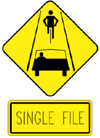
Single file These signs warn motorists and cyclists that cyclists may use the full lane ahead and that the lane is too narrow for side-by-side operation.  Yellow sign with a cyclist using the full vehicle lane and a vehicle following behind with the text single file
 Sharrows Sharrows remind road users to share the road and offer line-of-travel guidance to cyclists.  Directional triangle with an icon of a bicycle
Shared use pathway These signs indicate that a pathway can be used by both cyclists and pedestrians and that the space is to be shared by both users.  Green circle around an icon of a person and bicycle with the text shared pathway below the circle
Pedestrian and bicycle crossing These signs indicate to vehicles that a pedestrian and bicycle crossing is ahead.  Yellow sign with a pedestrian and cyclist icon

Registering your bicycle and keeping it locked properly are the best ways to prevent your bike from being stolen.

Register Your Bicycle

You can register your bicycle with Saugeen Shores Police Services. There is a $5 registration fee. Visit the police station to register your bicycle or call 519-832-2500 for more information

Bicycle Locking Tips

Invest in a high-quality, secure bike lock, such as a u-lock. They require more time to defeat compared to  chains or cable locks. 

Use a secure lock, like a u-lock

Store your bicycle inside or in a locked garage, whenever possible. Avoid locking your bike to the front porch or at the side of the house or garage. 

Park inside overnight or during longer durations of time

Lock the frame and wheel to a secure bike rack. When locking your bike outside, lock the frame and at least one wheel to secure bike rack such as an o-ring, wave or inverted-u rack. These types of bike parking are available in our downtown cores. 

Lock bike frame and wheel to secure rack

Be aware of what you're locking up to. Avoid using bike racks that are damaged or not properly anchored and avoid locking to objects that can be moved, dismantled or destroyed to free your bike.

Choose a bike rack that's secured to the ground

Lock your bike in visible, well-lit, high-traffic locations. The more visible your bike is, the less likely is it will be targeted for theft.

Lock your bike in visible, high-traffic, well-lit areas

Don't forget your accessories. Be sure to take your helmet and easily removed accessories with you.

Don't forget your bike accessories


  • Trails are for non-motorized use only. Mobility devices and e-bikes are permitted.
  • Pedestrians and mobility devices always have the right of way
  • Horses are allowed on the Woodland and Biener trails only.
  • Ride at a safe speed and in control, recommended maximum of 20 kilometres per hour.
  • Ride on the right, pass on the left.
  • When stopped, move safely off to one side of the trail.
  • Warn others you are passing by using your bell or calling out.
  • Keep dogs leashed and in your care and control.
  • Clean up after your dog. Pick up, bag and dispose of waste properly.
  • Show courtesy to all trail users. Share the trail.
  • Put garbage in its place. Leave no trace.
  • Stay on the trail. Respect private property and natural vegetation.

Using Your Bell

  1. Ensure your bicycle has a bell, it's the law
  2. Attach your bell to your handlebars for quick and easy access
  3. Ring 1 to 4 times well in advance (10 to 20 metres) to not alarm others
  4. Use it to announce you're approaching a road or trail user and intend to pass on their left
  5. Show respect for all trail and road users by using a bell and passing safely
  6. Remember that wheels always yield to heels. Pedestrians have the right of way, always wait to pass until safe to do so

The Importance of a Bicycle Bell

Anyone who rides a bike, including kids needs a bell. Bells are required by law under the Highway Traffic Act which states that "every bicycle shall be equipped with a bell and is sounded to notify others." Bells are cost effective way to improve safety for everyone. They:

  • Alert other trail users that you're approaching
  • Allow cyclists to safely navigate busy trails
  • Build respect and trust among trail users

Use your bell when cycling on trails or roadways and when approaching pedestrians or cyclists. If you hear a bell as a pedestrian, it means that someone on a bike is approaching and plans to pass. Please move to the right when it is safe to do so.


These videos offer quick reminders to keep cyclist and motorists safe while sharing the road.

Learn how you can help keep Saugeen Shores safe by respecting all users and obeying the rules of the road.

About Becoming a Bicycle-Friendly Community

In 2017, the Town of Saugeen Shores worked with Share the Road Cycling Coalition to develop a report and recommendations to become a Bicycle Friendly Community. Community engagement and a local infrastructure tour were part of the report process. In fall 2018, the Town was awarded its designation as a bronze bicycle friendly community.

Bronze Bicycle Friendly Community Badge